Not Every Lawyer Will Actually Fight for You — Here’s How to Spot the One Who Will
The night after the crash, you’re lying there running numbers in your head. Medical bills. Time off work. The adjuster who called before you even left the hospital. And somewhere in that fog, you start searching for a lawyer — and suddenly there are billboards, TV ads, intake forms, and promises of millions recovered. Everyone sounds like they’re on your side.
I spent years on the defense side of personal injury law, watching how cases actually move through a firm. I’ve seen the intake teams who are warm and attentive right up until you sign. I’ve seen cases handed to junior associates while the named partner’s face stays on the bus stop ad. I left that world because I got tired of watching injured people make expensive hiring decisions based on marketing instead of reality.
So let me tell you what actually matters.
What “Having a Lawyer” Actually Means — And What It Doesn’t
Here’s the scenario I see play out constantly: someone gets hurt, calls a firm with a recognizable name, has a warm conversation with an intake coordinator, signs a retainer, and exhales. They feel like they’ve done the hard part.
Months later, they realize they’ve never spoken to the attorney whose name is on the letterhead. Their calls go to a case manager. Settlement offers come and go without real explanation. They feel pressured to accept something that doesn’t cover their actual losses.
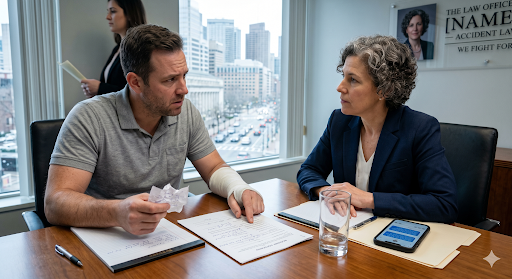
Contrast that with a different experience — someone who asked hard questions before signing anything. Who spoke directly to the attorney. Who understood exactly what the fee structure meant in dollar terms. That person walked into the attorney-client relationship with their eyes open, and it changed everything about how they were treated.
The difference wasn’t luck. It was preparation.
The Four Filters: What You’re Actually Evaluating
When you’re vetting a personal injury lawyer, you’re trying to answer one question: Will this specific person actually advocate for me, or am I a file number in a volume practice?
That question breaks into four real filters.
| Filter | What to Ask | Red Flag Answer |
|---|---|---|
| Who handles your case? | “Will you personally work my file?” | “Our team will take great care of you” |
| Relevant experience | “Have you handled cases like mine?” | Vague references to “all types of injury cases” |
| Trial history | “How many jury trials in the last 3 years?” | Claims a perfect record, or can’t answer |
| Fee structure | “Who pays litigation costs if I lose?” | Rushing past the retainer agreement |
Ask these questions in the first conversation. A good attorney won’t be offended. A settlement mill will give you soft, reassuring non-answers — and that’s exactly the information you need.
Credentials: What Matters, What Doesn’t
Legal credentials matter more than most injured people realize — and less than some attorneys want you to think.
State bar membership is baseline. What you’re looking for beyond that is demonstrated focus. Personal injury law is a specialty, and an attorney who primarily handles estate planning or business contracts and occasionally takes injury cases is not the same as someone whose entire practice is built around it.
Three credential markers worth your attention:
- Board certification in civil trial law or personal injury — Not every state offers these, but where they exist, they signal a lawyer who has invested in the discipline beyond the minimum.
- Trial experience, specifically — Adjusters track which attorneys litigate and which ones settle. If your attorney has a reputation for taking cases to verdict when necessary, the insurer’s opening offer will reflect that. If they’re known for quick settlements, you may be offered less from the start.
- Jurisdictional depth — An attorney who knows the local courts, local judges, and local jury tendencies brings practical leverage that credentials alone don’t capture.
Ask directly: “How many cases have you taken to trial in the last three years, and what were the outcomes?” A legitimate attorney will answer this honestly, including the losses. Anyone who claims a perfect record is either lying or hasn’t tried enough cases to have lost one.
A personal injury lawyer boston who handles cases through trial — not just through settlement — brings a fundamentally different kind of leverage to your claim. That leverage is real, and it’s worth asking about before you sign anything.
Reputation: A Skeptic’s Reading Guide
The reputation management landscape around personal injury firms is genuinely complicated. Firms invest heavily in their online presence — and some of that investment is legitimate, some of it is noise.
Here’s how to read it accurately.
Online reviews are useful but manipulable. A firm can have 200 five-star reviews and still be a settlement mill — volume practices often have excellent intake experiences that generate glowing early reviews before clients realize what’s happening. Focus on specificity. Generic praise (“great lawyer, highly recommend!”) tells you almost nothing. Look for reviews that describe how the attorney communicated during difficult moments, whether they explained options clearly, and whether the client felt informed or just processed.
Verdict and settlement figures on firm websites deserve skepticism. “We recovered $X million for our clients” is a marketing statement, not a performance guarantee. Case outcomes depend on facts, injuries, liability, insurance limits, and jurisdiction — none of which are constant. A firm that recovered a large verdict in a catastrophic injury case tells you nothing about how they’ll handle your soft-tissue claim.
Bar association records are underused. The Massachusetts Board of Bar Overseers maintains a public lookup tool where anyone can search an attorney by name and review any disciplinary or reinstatement decisions on record. A single complaint doesn’t necessarily disqualify an attorney, but a pattern of client communication issues or fee disputes is a real signal. Spend ten minutes checking before you sign — it’s free, it’s public, and most people never do it.
The Contingency Fee: Reading the Fine Print
Most personal injury lawyers work on contingency — they only get paid if you recover money. That’s genuinely good for injured people who can’t afford hourly rates.
But “no fee unless you win” is not the whole picture.
In Massachusetts, contingency fees for personal injury cases typically range from 25% to 40%, depending on the complexity of the case and whether it goes to trial — with 33⅓% being the most common figure for standard claims, as outlined in Rule 1.5 of the Massachusetts Rules of Professional Conduct.
What “litigation costs” actually includes: Filing fees, expert witness fees, deposition transcripts, medical record retrieval, accident reconstruction specialists. In a complex case, these can easily reach $10,000–$30,000 or more.
Some firms advance these costs and deduct them from your settlement at the end. Others expect you to pay as you go. The difference matters enormously if your case takes two years and involves multiple expert witnesses.
Ask these questions before you sign:
- “Who pays litigation costs, and when?”
- “If I don’t recover anything, am I responsible for those costs?”
- “What happens if I want to reject a settlement offer?”
That last question is important. You have the right to make that call — it’s your case, your injury, your life. Some attorneys will pressure clients toward settlement because trials are expensive and uncertain. Understanding your rights within the attorney-client relationship before you’re in that moment gives you real leverage when it counts.
Get all of this in writing. A retainer agreement that’s vague about cost responsibility is a problem waiting to happen. A good attorney will walk you through the fee agreement line by line. If they rush you past it, that’s information.
Red Flags: The Subtle and the Obvious
Some warning signs announce themselves. Others require attention.
The obvious ones:
- Guarantees a specific outcome or dollar amount before reviewing your medical records
- High-pressure “sign today” energy during intake
- Can’t tell you who will actually handle your case
The subtle ones:
- The attorney seems unfamiliar with the specific facts of your situation during the consultation — possible sign they’re running too many files to give yours real attention
- Responsiveness during intake is slow or inconsistent — this is a preview, not an anomaly
- Reviews are uniformly positive about the initial experience but go quiet about what happened during the case
One pattern I saw repeatedly on the defense side: firms that were exceptional at signing clients and mediocre at everything after. The intake coordinator was warm, responsive, and thorough. The case manager who took over three weeks later was overwhelmed. The attorney who appeared at mediation had read the file that morning.
If it takes days to return your calls before you’ve even signed, it won’t get better after.
Before You Sign: A Quick-Reference Checklist
You don’t need to have everything figured out before your first consultation. You do need to go in with specific questions and the willingness to walk away if the answers aren’t good enough.
Do this before signing anything:
- [ ] Speak directly with the attorney who will handle your case — not just the intake coordinator
- [ ] Ask about trial experience and outcomes, including losses
- [ ] Confirm the fee percentage and when it changes (pre-trial vs. trial vs. appeal)
- [ ] Clarify who pays litigation costs and what happens if you recover nothing
- [ ] Check the state bar’s public disciplinary database
- [ ] Read the retainer agreement in full, specifically sections on fees, costs, and settlement authority
The Bottom Line
Here’s what I want you to take from all of this.
The personal injury legal market is large, competitive, and heavily marketed. Most firms are not bad actors — but many are volume operations that will give your case adequate attention rather than genuine attention. The difference between those two things can be tens of thousands of dollars, or the difference between a settlement that covers your losses and one that doesn’t.
You’ve already been through something hard. The attorney you hire should make the next part easier, not more uncertain.
The right one exists. They’ll answer your questions directly, explain the fee agreement without rushing, tell you honestly about cases they’ve lost, and give you a clear answer about who will actually be working your file. When you find that person, you’ll know — because the conversation will feel different from the sales pitch you’ve been getting everywhere else.
Now you know what to look for.